Moose browsing
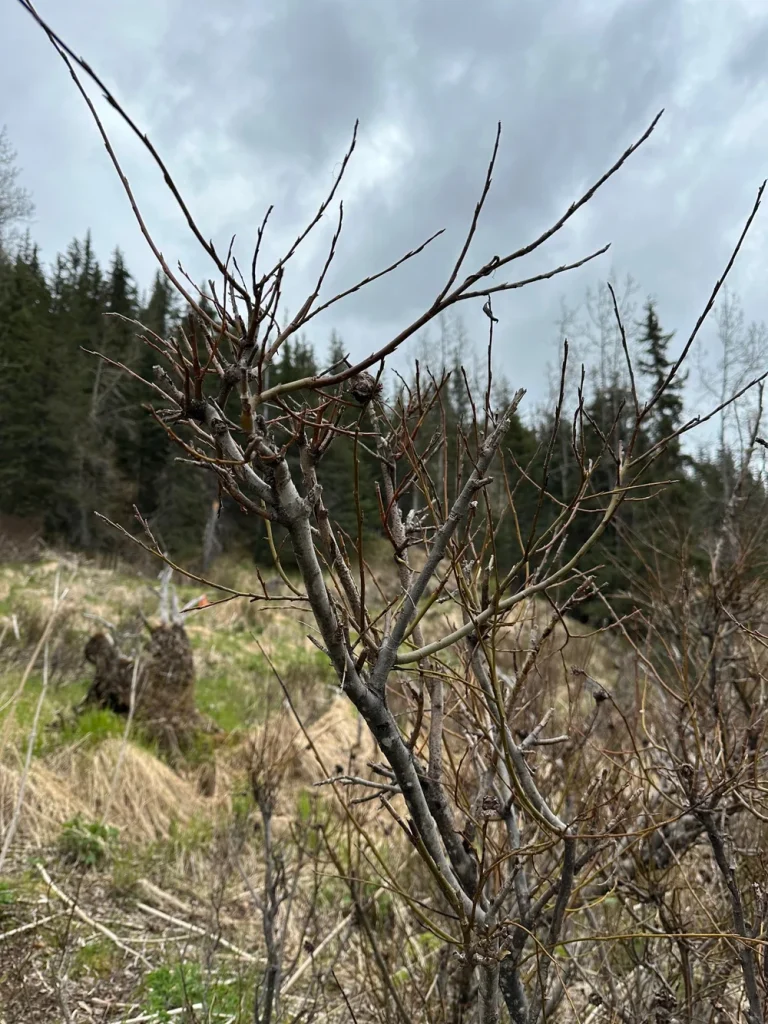
Picture shows an early season (May 22nd) willow along the Twitter Creek Floodplain which was food for moose over winter.
Small shoots radiating from the limbs of willow display the results of browsing moose. Many species including willow are important to the moose diet, which varies from winter to summer.
In winter, moose eat birch (Betula papyrifera), lowbush cranberry (Vaccinium vitis-idaea), willow (Salix spp.), alder (Alnus spp.), and and foliose lichens (Peltigera spp.).
In summer, moose eat birch (Betula papyrifera) and a variety of forbs, grasses, sedges and aquatic plants, as well as willow (Salix spp.).
References: LeResche, Robert E. and James L. Davis. Importance of Nonbrowse Foods to Moose on the Kenai Peninsula, Alaska. The Journal of Wildlife Management, July 1973.

Spruce Bark Beetle
Picture shows beetle tracks throughout the woody part of the tree below where the bark once covered.
Spruce Bark Beetle infestation cycles have been recurring in northern forests and the Kenai Peninsula for hundreds of years, typically around 50-year cycles. These beetles attack large mature spruce trees eventually killing them. In the 1990’s the Kenai Peninsula had a particularly devastating infestation, aggravated by unusually warm summers. The 1990 infestation decimated the spruce forests in the whole region including here at Twin Rivers Wilderness.
When the thick spruce forest on Jack Easterday’s 480-acre homestead was overtaken by beetles in mid-1990, he opted to sell the property to Buffalo Timber company, since the parcel was large enough to justify its own logging operation to harvest the standing dead spruce. Most other local landowners just endured standing dead spruce trees which eventually fell, and completely reorganized the local forests into meadows and alder thickets and new immature forests, and sometimes to eventually better views. Here at Twin Rivers, the generally level upper areas were logged, but the slopes were not logged, and you can observe the contrasts when you hike from the upper-level areas with healthy standing trees and some moss-covered stumps, to the side slopes where travel is very difficult among fallen trees everywhere commingled with the new growth trees. Exercise care and caution when hiking off-trail on the valley slopes–you will be stepping and climbing over an expanse of fallen timber.
Spruce Bark Beetle Outbreaks on the Kenai Peninsula, Alaska. Forest Ecology and Management, June 2006.

Game Trails
Picture shows an early season (May 22nd) relict ATV trail that has been taken over as primarily a moose trail.
Game trails abound at Twin Rivers. Uniquely situated partially within the Anchor River/Fritz Creek Critical Habitat Area, we are on and adjacent to a refuge established to provide habitat for Alaska wildlife, especially moose.
The ATV trail at Twin Rivers Wilderness was abandoned years prior, with the moose and bear taking advantage of the easier passage along the trail where fallen spruce were cut or cleared in the past. The left side of the dual track ATV trail can be faintly seen left of the new game trail. This picture was taken during the very first walk of this trail, prior to any human traffic in a couple of years.
Anchor River/Fritz Creek—Critical Habitat Area. State of Alaska, Department of Fish and Game.
Bear Claw Sharpening
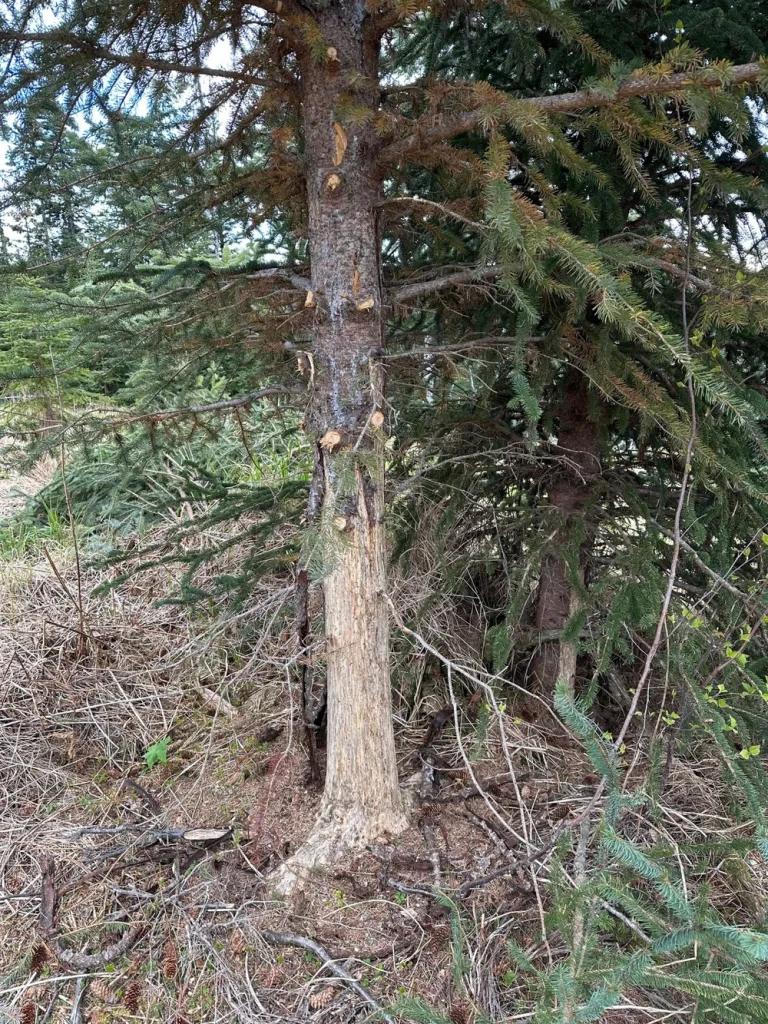
Picture shows a trail’s edge spruce tree that has had almost all of its lower bark removed, likely from a bear.